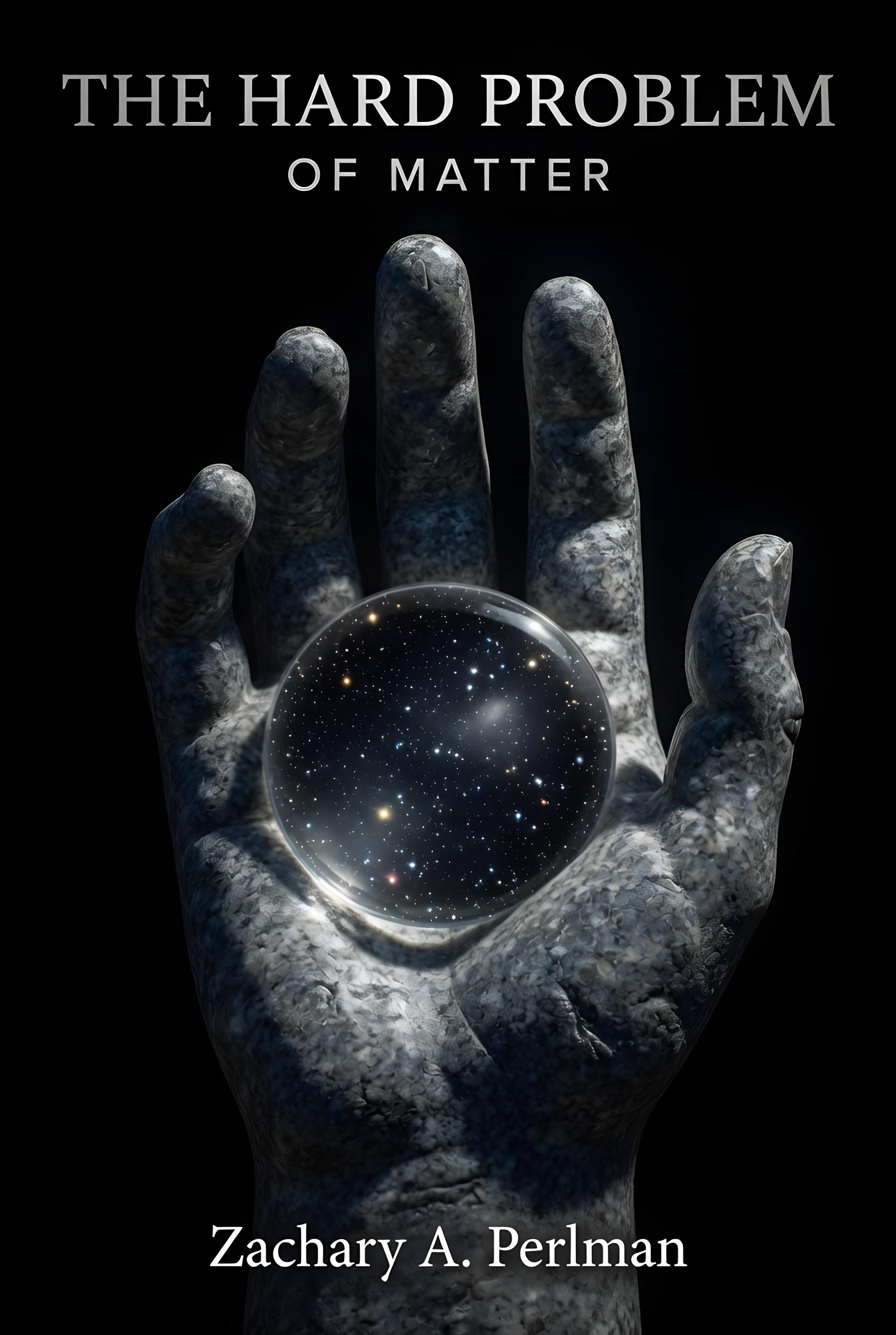
A Philosophy of Physical Reality

The Hard
Problem
of Matter

Substance as the First Mystery

We have asked what explains experience. We have rarely asked
what explains matter: why dense, persistent, extended substance
appears at all within the field of awareness, and what it ultimately is.

Descend
"The solidity you touch is not the ground.
Experience is the ground, and matter
is experience in its densest form."

David Chalmers famously identified consciousness as the hard problem for physicalism: no amount of third-person description explains why there is something it is like to be a mind. But the inverse problem has gone largely unexamined. For those who begin with awareness as the fundamental datum, matter becomes the mystery: why does the formless field of knowing appear to encounter resistance, weight, and extension? The Hard Problem of Matter enters this inversion with rigorous philosophical attention and the orientation of nondual inquiry.

I
Dense

Matter presents as impenetrable, resistant, and self-consistent. It pushes back. It persists when unobserved. It occupies space with a kind of insistence that consciousness does not. This quality of density is not explained by pointing to molecules; it must be accounted for at the level of experience itself.

II
Empty

Modern physics has disclosed a paradox: what appears most solid is, at the quantum scale, almost entirely void. The atom is overwhelmingly space. The particle is a probability distribution. Solidity, then, is a feature of a certain level of description, not of matter as such. What is the substance of substance?

III
Experiential

All contact with matter (every texture, weight, and resistance) is mediated through experience. The rock is never encountered outside of sensation. This does not deny the rock; it reframes the question. Matter does not exist outside of awareness's encounter with it, which makes that encounter, not the matter, the primary fact.

Five Investigations

The Architecture of the Inquiry

01
The Phenomenology of Solidity

Before theorizing matter, we must describe it faithfully as it appears. What is the texture of encountering something that resists? What constitutes the experience of weight, boundary, or impenetrability? Phenomenological precision precedes all other inquiry, and most physicalist accounts skip this step entirely, trading description for explanation before the description is complete.

"Density is not a property discovered by physics. It is first a quality given in touch."
02
The Physics of the Void

Quantum field theory, wave-particle duality, and the measurement problem have each, in their own way, destabilized the commonsense notion of solid, observer-independent matter. This is not mysticism dressed in scientific language. It is an honest reckoning with what contemporary physics has disclosed: that matter, at its most fundamental level, resists the category of substance as traditionally conceived.

"The closer we look, the less matter resembles the matter we thought we knew."
03
Matter as a Modality of Awareness

Kashmir Shaivism, Advaita Vedanta, and Dzogchen each (though using different language) converge on a view in which the physical world is not the ground upon which consciousness rests, but rather a particular modality or expression of consciousness itself. The dense, the extended, the persistent: these are qualities that awareness assumes or enacts, not a domain that precedes and produces awareness.

"Everything is the play of Shiva — including the stone that breaks your foot."
04
The Body as Living Question

The body is the locus where the problem becomes personal. It is matter that feels. It is the site where materiality and subjectivity are not merely adjacent but identical. The ache in the knee is not a physical event that consciousness then registers. It is the very mode by which awareness takes on density and locality. Understanding the body philosophically is understanding matter from the inside.

"The body does not carry consciousness. The body is consciousness in its gravitational form."
05
Dissolving the Material–Immaterial Divide

The hard problem of matter ultimately reveals that the division between the material and immaterial, between the physical and the conscious, is a conceptual artifact, a cut made for practical reasons that has been mistaken for an ontological reality. Both sides of the divide are modes of appearing. The resolution is not to privilege one over the other, but to recognize the ground from which both arise: awareness itself, neither material nor immaterial.

"The boundary between matter and mind was never a fact. It was always a convenience."

Key Terms

A Philosophical Glossary

The Hard Problem (Inverted)

Chalmers asked why physical processes produce subjective experience. The inversion asks: if awareness is primary, why do material processes appear at all, and with the particular characteristics they possess: resistance, extension, persistence? Both problems share the same root: any explanation that begins inside one domain cannot account for the appearance of the other.

Ontology
Apparent Solidity

The quality of impenetrability that characterizes matter at the scale of ordinary experience: the resistance of stone, the firmness of ground underfoot. Apparent solidity is distinguished from physical solidity (a property of particle interactions) and recognized as a phenomenal quality, not an ultimate description of what matter is. It is real as appearance, and empty as essence.

Phenomenology
Ontological Inversion

The philosophical move of reversing the traditional priority relation between matter and consciousness, treating awareness not as a product of complex material processes, but as the medium within which matter and all apparent materiality appear. This is not idealism in the Berkeleyan sense; it is a move that brackets the question of what exists independently and focuses on what can be observed as primary.

Metaphysics
The Measurement Problem

In quantum mechanics, the measurement problem concerns how and why a quantum system in superposition collapses to a definite state upon observation. Various interpretations handle this differently, but all must contend with the role of measurement (and often, of the observer) in determining physical outcomes. This anomaly in physics is not a curiosity; it is a fissure through which the hard problem of matter enters science itself.

Philosophy of Physics
Panpsychism and Its Limits

Panpsychism holds that experience is a basic feature of reality, present at all levels of physical organization. It resolves the emergence problem by removing the need for consciousness to appear from nothing. However, panpsychism typically retains matter as fundamental and asks only that experience be woven throughout it. The inversion proposed here goes further: not that matter has experience, but that experience is what matter appears within.

Philosophy of Mind
Density as a Phenomenal Quality

Density, understood as the felt sense of mass, weight, heaviness, and gravitational pull, is treated not as a physical measurement but as a phenomenal quality: a characteristic of how awareness experiences certain kinds of appearance. Just as redness is not a property of electromagnetic radiation but of how a particular frequency appears to a visual system, density is how awareness encounters what physics measures as mass-energy distribution.

Consciousness Studies

"The mystery is not why matter produces consciousness.
The mystery is why consciousness takes the form
of something that seems to resist itself."

Materialism left the hard problem of consciousness unsolved. The nondual inversion inherits a symmetrical challenge: and this book accepts it directly, without evasion.

How the Problem Unfolds

Materialism's Premise
The Hard Problem of Consciousness
Failure to Account for Experience
Ontological Inversion: Awareness as Ground
The Hard Problem of Matter
Phenomenological Investigation
Dissolution of the Divide

Diagnosis

The classical error is treating matter as an independent, self-subsisting domain and then asking how consciousness could possibly arise from it. This starting assumption imports the conclusion before inquiry begins.

Inversion

The inversion does not deny matter. It relocates the explanatory burden: rather than asking how consciousness emerges from matter, we ask how matter (as a phenomenal category) appears within the field of awareness.

Resolution

Neither consciousness nor matter is the final word. Both are modes of appearing. The ground is awareness as such: open, indestructible, and prior to any distinction between the material and the experiential.

The Hard Problem of Matter cover

What the Book Does

Philosophy has long struggled to explain how consciousness could arise from matter. This book proposes that we have been asking the question in the wrong direction. Beginning from the foundational insight of nondual philosophy: that awareness is the irreducible ground of all experience. It poses the inverse challenge: what is matter, if awareness is primary?

Drawing on phenomenology, philosophy of physics, and the nondual traditions of Kashmir Shaivism, Dzogchen, and Advaita Vedanta, The Hard Problem of Matter does not retreat into abstraction. It traces the experience of solidity, weight, resistance, and extension from the inside, beginning with the body and moving outward toward the cosmos, and finds at every level that the material is never encountered outside of awareness's meeting with it.

This is not a denial of matter. It is an honest reckoning with what matter is, when honesty is followed all the way down.

Part One — The Problem Stated
Prologue: The Stone and the Seeing1
Chapter One — What Is the Hard Problem of Matter?11
Chapter Two — Materialism and Its Unsolved Residue29
Chapter Three — The Inversion: Starting Over from Awareness47
Part Two — The Phenomenology of Physical Reality
Chapter Four — Touching the World: The Phenomenology of Solidity67
Chapter Five — Weight, Gravity, and the Ground Beneath the Ground85
Chapter Six — Extension, Space, and the Sense of Outside103
Chapter Seven — The Body: Matter That Knows Itself121
Part Three — Physics at the Edge of Matter
Chapter Eight — The Quantum Unsettling of Substance143
Chapter Nine — The Measurement Problem and the Role of Observation161
Chapter Ten — Fields, Void, and the Absence of Solid Ground179
Part Four — Matter in the Nondual Traditions
Chapter Eleven — Kashmir Shaivism: Everything as Shiva199
Chapter Twelve — Dzogchen and the Luminous Nature of Appearances219
Chapter Thirteen — Advaita: The World as Neither Real Nor Unreal237
Chapter Fourteen — Synthesis: A Nondual Philosophy of Physical Reality255
Coda
Chapter Fifteen — Living in the World That Is Not What It Seems275

Passages

From the Text